Overview
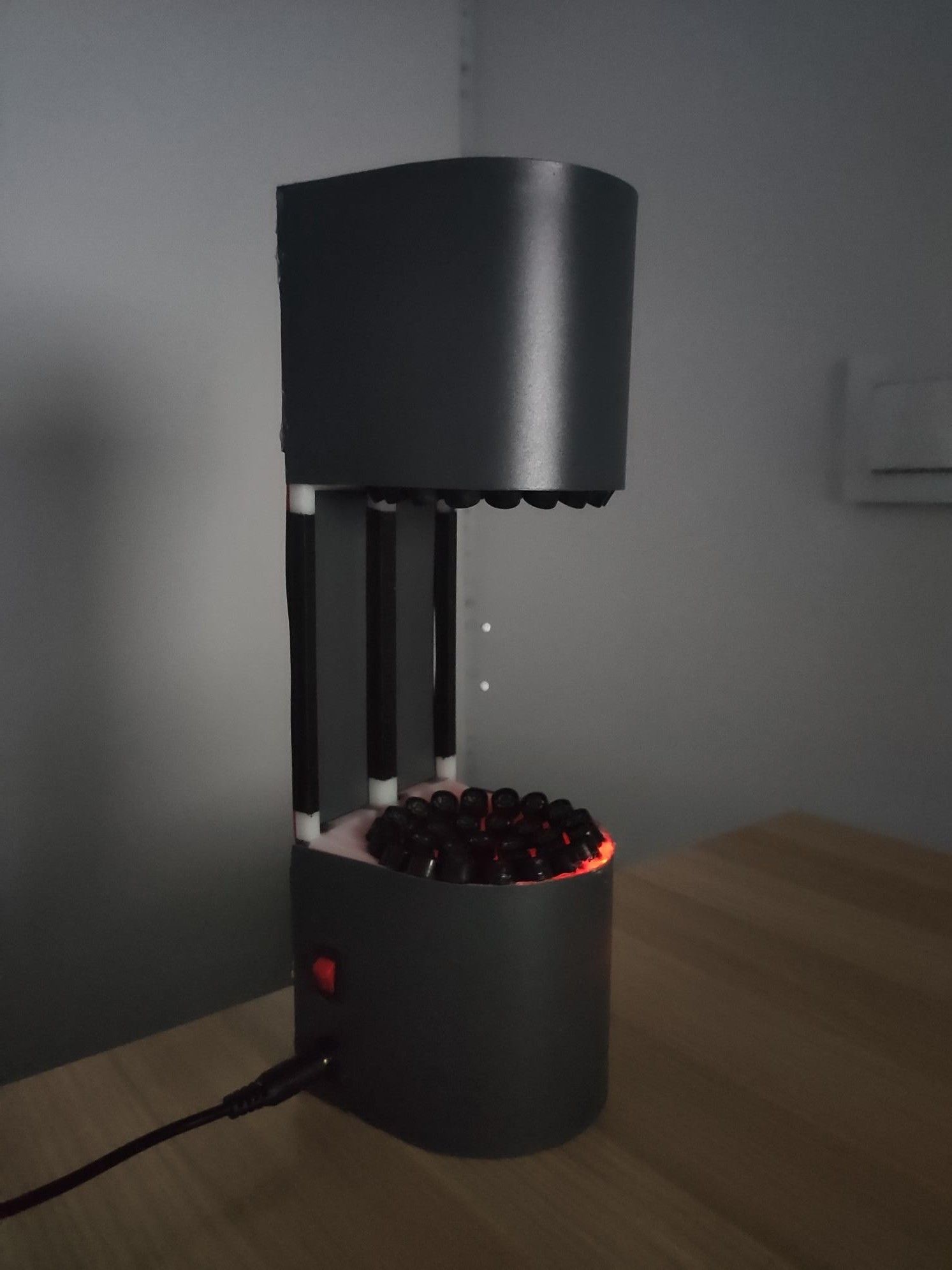
Can sound hold an object in mid-air, and measure itself while doing it? For my high-school research project I built a single-axis acoustic levitator, in which a standing ultrasonic wave traps small particles at its nodes. Measuring the spacing between those nodes gave the speed of sound: 343.2 ± 8.6 m/s at 20 °C, in line with the accepted value, falling to 328.5 m/s at 4 °C. I also measured how much the levitator can lift: about 13 mg.
How the levitator works
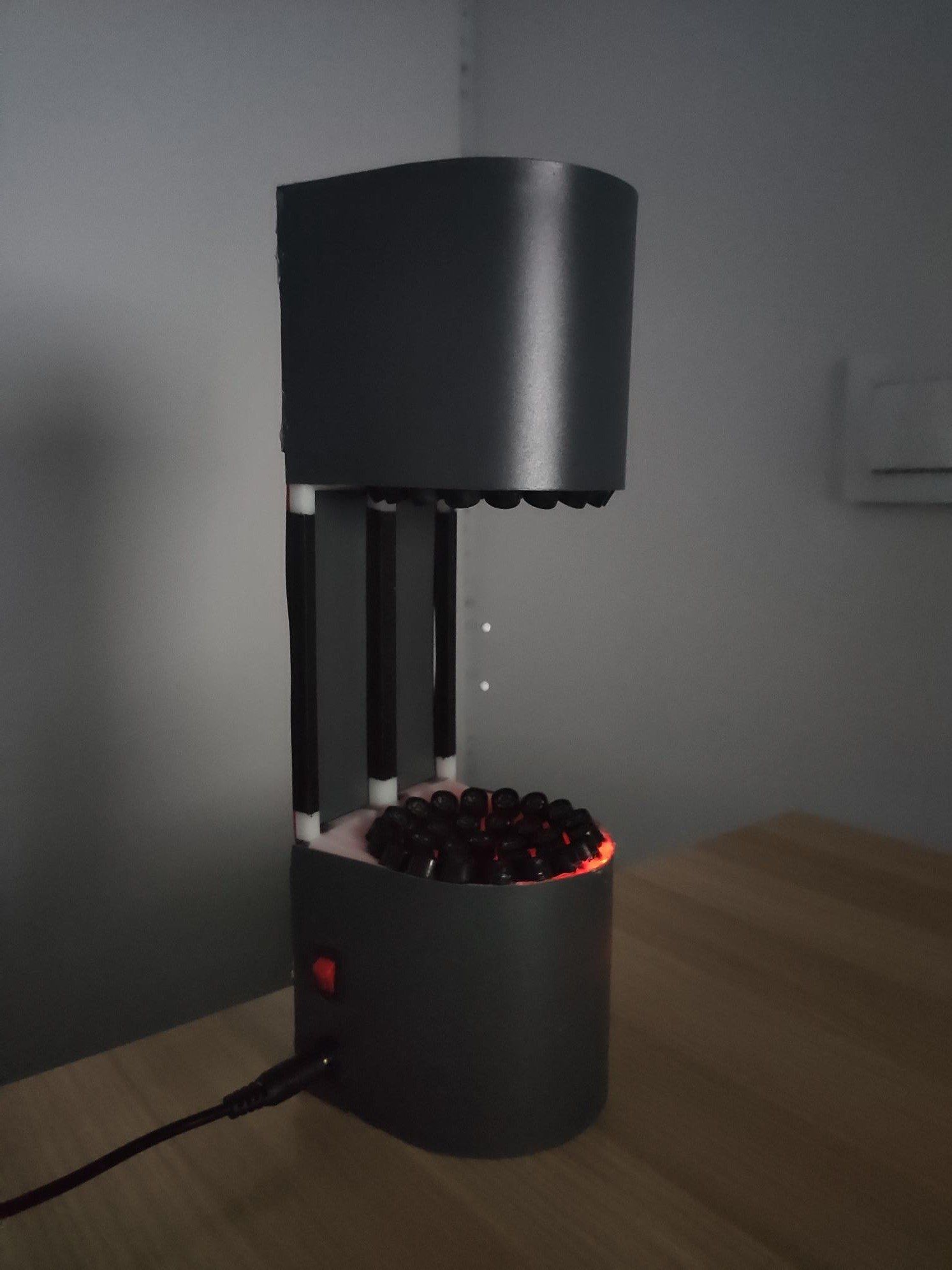
Two arrays of ultrasonic transducers face each other and emit at the same frequency. Their waves interfere and form a standing wave between the arrays. Small, light objects stay suspended at the pressure nodes, where the acoustic radiation force balances their weight.
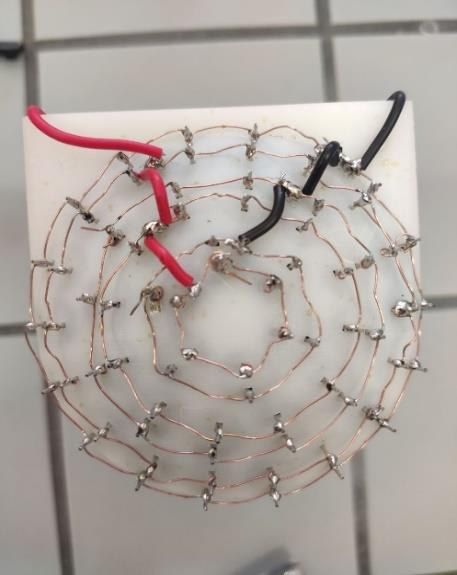
The device has 72 transducers mounted in rings of 6, 12 and 18 on each half of a 3D-printed frame. An Arduino Nano drives them through an L298N driver, powered by a 9 V adapter. I assembled it from a kit that follows a published design for a single-axis, non-resonant levitator (C. Álvarez Folkmann, 2020), and the Arduino program came with that design. The measured drive frequency was (38.3 ± 1.0) kHz.
Before mounting the transducers I checked the polarity of each one with a multimeter, because the factory marking can be wrong.
Speed of sound from the node spacing
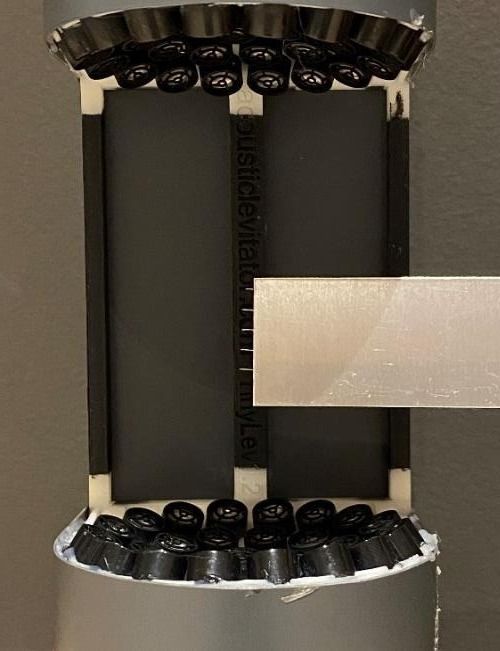
Consecutive nodes of a standing wave are half a wavelength apart. With the drive frequency known, the speed of sound follows from the node spacing:
where is the distance between consecutive nodes and the drive frequency.
I levitated several pieces of paper at once and photographed them next to a metal reference piece whose length I had measured with a calliper (28.95 mm). In Logger Pro I scaled each photo with the reference and measured the distance between neighbouring particles. Each temperature has nine replicas.
| Temperature | Node spacing | Speed of sound |
|---|---|---|
| 20 °C | 4.480 ± 0.113 mm | 343.2 ± 8.6 m/s |
| 4 °C | 4.288 ± 0.076 mm | 328.5 ± 5.6 m/s |
At 20 °C the result agrees with the usual value of 343 m/s within its uncertainty.
Effect of temperature
The speed of sound drops as air gets colder. With the frequency fixed, the wavelength and therefore the node spacing must shrink. I repeated the measurement at 4 °C in a cold room. The mean node spacing fell from 4.480 mm to 4.288 mm, 4.3 % less, and the speed of sound fell by the same fraction, from 343.2 m/s to 328.5 m/s.
Maximum mass and force
To find how much the levitator can hold, I added drops of distilled water with a micropipette to a levitating piece of filter paper until it fell, then weighed it on a precision balance with a resolution of 0.1 mg. Weighing the piece avoided errors from evaporation.
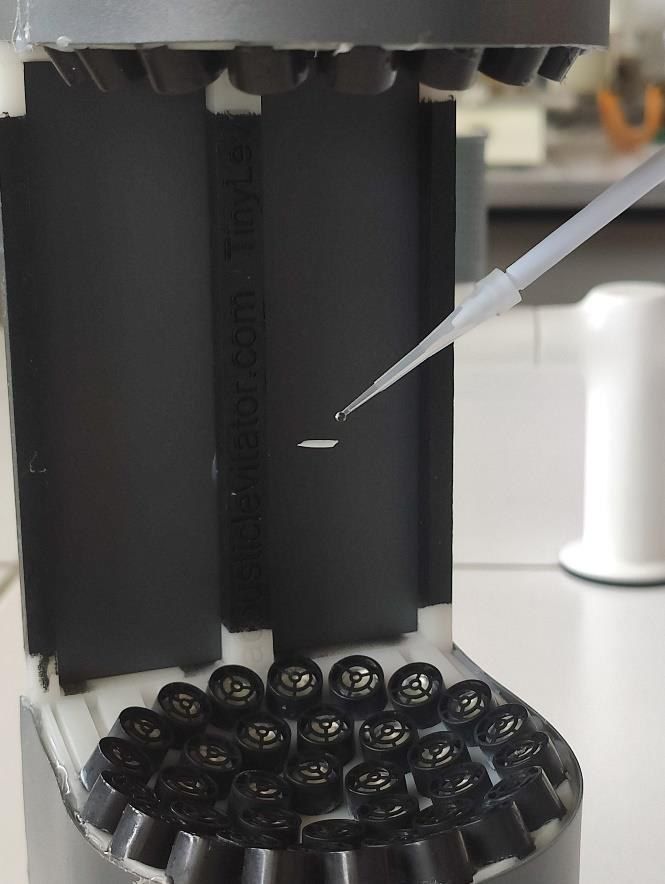
Six trials gave 17.7, 11.7, 16.3, 11.5, 12.7 and 13.4 mg, a mean of 13.9 ± 1.1 mg (standard error of the mean). Each drop added about 2 mg, so the largest mass the levitator held lies between about 11.9 and 13.9 mg.
At the limit the acoustic force balances the weight, . For 13.9 mg this gives about N, and about N for 11.9 mg: the levitator can only hold very light particles.
Limitations
The main sources of error are the calliper measurement of the reference piece, placing the particle positions by eye in Logger Pro, and the uncertainty of the transducer frequency. The temperature study has only two points, so it shows the trend but not the law; measuring from −40 to 40 °C would allow fitting one. The mass trials were difficult to carry out: the paper often stuck to the pipette tip, and several pieces were lost before they could be weighed.